1. Introducción
The Roland A-49 is a lightweight, slim-line MIDI keyboard controller designed for musicians seeking a simple, easy-to-use device with professional-quality playing feel. It features a premium-grade, full-size keyboard, making it suitable for both home studios and live performances. The A-49 is available in black and pearl white finishes.

Image: The Roland A-49 MIDI Keyboard Controller integrated into a home studio environment, showcasing its compact design alongside other music production equipment.
2. Características principales
- 49 teclas de tamaño completo: Equipped with velocity sensitivity for expressive performance.
- Diseño ligero y compacto: Easy to transport and fits into various setups.
- Controles intuitivos: Features two assignable knobs, two assignable switches, and a D-BEAM controller for dynamic sound manipulation.
- Alimentación por bus USB: Eliminates the need for an external AC adapter, simplifying setup.
- Stable Keyboard Action: Designed to prevent key twisting and lateral movement for consistent playability.

Image: A visual representation of the Roland A-49's compact size, shown next to a human silhouette to provide a sense of scale and portability.
3. Guía de configuración
3.1 Conexión a una computadora
- Instalar controladores: Before connecting, download and install the latest drivers for your operating system (Windows/Mac) from the official Roland websitio.
- Conecte el cable USB: Connect the USB Type B port on the A-49 to a USB port on your computer using a standard USB cable. The A-49 is USB bus powered, so no external power adapter is typically required.
- Encendido: The device should power on automatically once connected to your computer.
- Reconocimiento de software: Open your Digital Audio Workstation (DAW) or music production software. The A-49 should be recognized as a MIDI input device. Configure your software to use the A-49 as its MIDI controller.
3.2 Connecting External Pedals
The A-49 features input jacks for external pedals, enhancing your performance capabilities:
- DampEl pedal: Connect a sustain pedal to the DAMPER jack for piano-like sustain.
- Foot Switches (FC1, FC2): Connect optional foot switches to the FC1 and FC2 jacks for assignable control over various functions within your software.

Image: The rear panel of the Roland A-49, displaying the USB Type B port for computer connection, MIDI OUT, and input jacks for Damper, FC1, and FC2 pedals.
4. Instrucciones de funcionamiento
4.1 Reproducción básica
Once connected and recognized by your music software, you can begin playing virtual instruments or controlling MIDI-compatible hardware. The 49 velocity-sensitive keys respond to your playing dynamics.
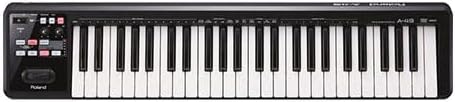
Imagen: Una vista clara de arriba hacia abajo view of the Roland A-49 MIDI Keyboard Controller, highlighting its 49 full-size keys and control panel.
4.2 Perillas y interruptores de control
The A-49 features two assignable control knobs (C1, C2) and two assignable switches (S1, S2). These can be mapped to various parameters within your DAW or software synthesizers, such as filter cutoff, resonance, effects send, or modulation depth. Refer to your software's manual for MIDI mapping instructions.

Image: A close-up of a hand turning one of the assignable control knobs on the Roland A-49, demonstrating interaction with the controller's features.
4.3 D-BEAM Controller
The D-BEAM controller allows for expressive control by waving your hand over an infrared sensor. It can be assigned to control pitch, volume, or other parameters, offering a unique performance element.
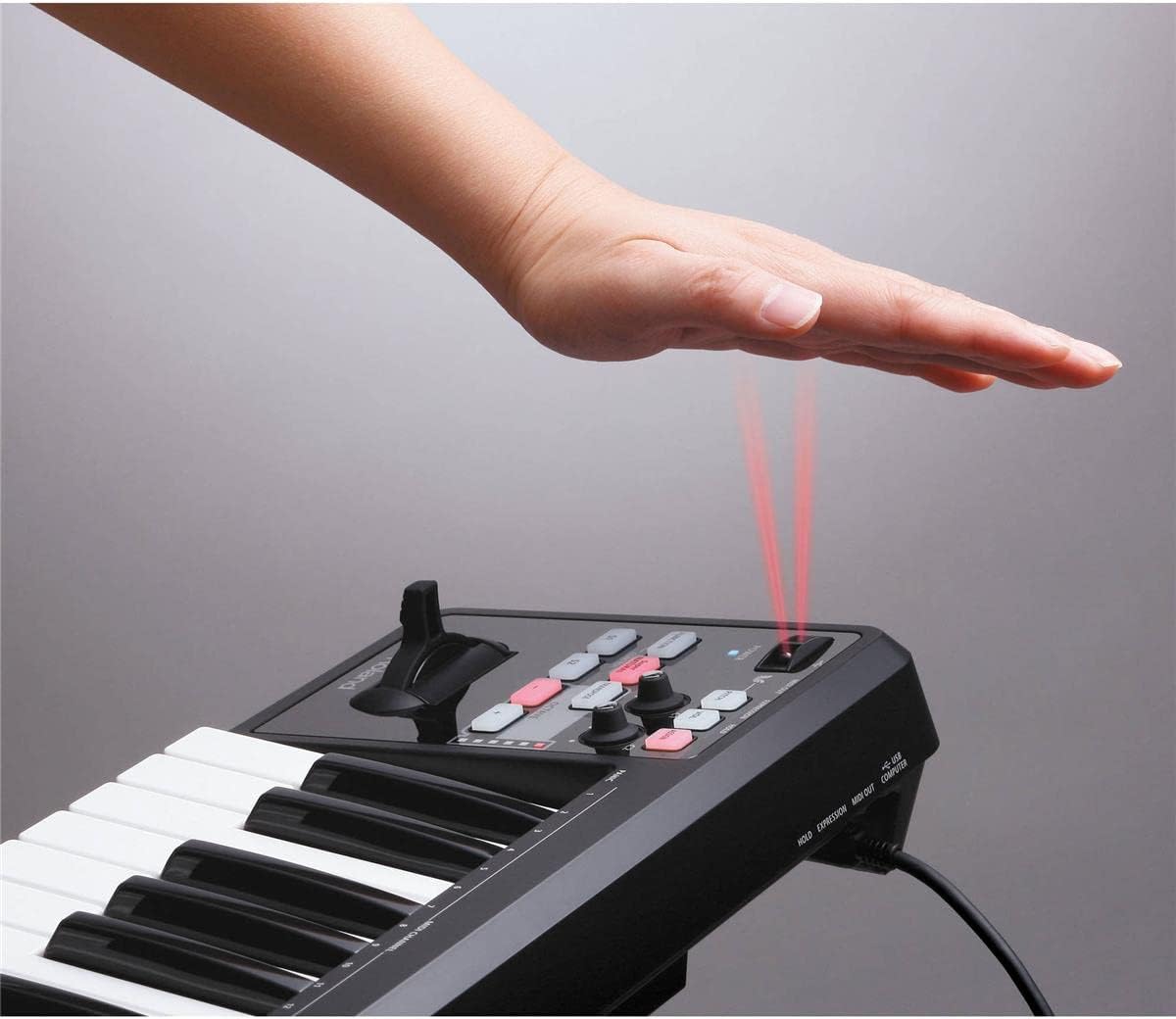
Image: A hand hovering over the D-BEAM controller on the Roland A-49, illustrating the gesture-based control mechanism.
4.4 Botones de octava y transposición
Use the OCTAVE +/- buttons to shift the keyboard's pitch range up or down in octave increments. The TRANSPOSE button allows for semitone adjustments. LED indicators provide visual feedback on the current octave setting.
4.5 Pitch Bend/Modulation Lever
The combined pitch bend and modulation lever provides dynamic control over pitch and modulation effects, allowing for expressive bends and vibrato.
5. Compatibilidad del software
The Roland A-49 is compatible with a wide range of music production software on both Windows and Mac operating systems. It is designed to integrate seamlessly with most Digital Audio Workstations (DAWs) and software synthesizers that support USB MIDI keyboards.
5.1 Software incluido
The A-49 may come bundled with Cakewalk SONAR LE software, allowing users to start creating music immediately upon setup.
5.2 iPad Connectivity
For mobile music production, the A-49 can be connected to an Apple iPad using an Apple iPad Camera Connection Kit. This enables control over various music applications on your iPad.
Video: An official product video from Roland showcasing the features and connectivity of the A-49 MIDI Keyboard Controller, including its compatibility with various software and devices.
6. Mantenimiento
- Limpieza: Utilice un paño suave y seco para limpiar la superficie del mando. Para la suciedad difícil, utilice un paño ligeramente seco.amp Se puede usar un paño con jabón suave y luego un paño seco. Evite limpiadores abrasivos o disolventes.
- Almacenamiento: Store the A-49 in a cool, dry place away from direct sunlight, extreme temperatures, and high humidity. If storing for extended periods, cover it to protect from dust.
- Manejo: Handle the controller with care to prevent damage to keys, knobs, and ports. Avoid dropping or placing heavy objects on it.
7. Solución de problemas
7.1 Dispositivo no reconocido
- Instalación del controlador: Ensure that the correct drivers for your operating system are installed from the Roland websitio.
- Conexión USB: Try connecting to a different USB port or using a different USB cable. Ensure the cable is securely connected.
- Reiniciar la computadora: Sometimes a computer restart after driver installation can resolve recognition issues.
- Advanced MIDI Control (Mac Users): If experiencing issues on Mac, some users have reported success by turning off "advanced MIDI control" by hitting Function + ADV + the "minus" button on the controller.
7.2 Los controles no responden
- Mapeo MIDI: Verify that the controls (knobs, switches, D-BEAM) are correctly MIDI-mapped within your DAW or software instrument.
- Ajustes de octava/transposición: Check the octave and transpose settings to ensure you are playing in the desired range.
8. Especificaciones
| Marca | Roland |
| Nombre del modelo | A-49-BK |
| Número de llaves | 49 |
| Tipo de clave | Full-size, Velocity-sensitive |
| Tecnología de conectividad | USB |
| Tipo de conector | 1/4-inch phone type (for pedals), MIDI OUT, USB Type B |
| Interfaz de hardware | USB |
| Fuente de poder | USB Bus Powered (optional AC adapter available) |
| Dispositivos compatibles | PC, Mac, iPad (via Apple iPad Camera Connection Kit) |
| Sistema operativo | Ventanas, MacOS |
| Peso del artículo | 6 libras |
| Dimensiones del producto | 33 x 3 x 7 pulgadas |
9. Garantía y soporte
Para obtener información detallada sobre la garantía, consulte la tarjeta de garantía incluida con su producto o visite el sitio web oficial de Roland. webSitio web. Roland ofrece soporte al cliente y recursos para el registro de productos, actualizaciones de software y asistencia técnica.
Recursos en línea:
- Registro de producto
- Descargas de controladores y software
- FAQs and knowledge base
- Contactar con soporte técnico
Always ensure you are using the latest drivers and firmware for optimal performance and compatibility.


